My Thoughts
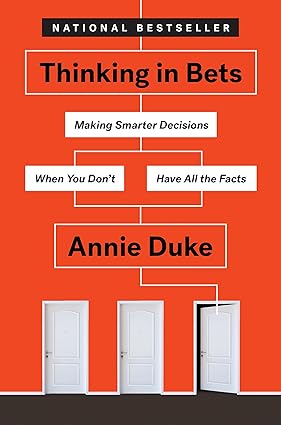
Annie Duke’s book, “Thinking in Bets,” explores the world of decision-making and the intriguing interplay between decision quality and luck. It offers a fresh perspective on decision-making, challenging conventional wisdom and providing valuable tools for making more rational and effective choices in an uncertain world. By focusing on the process, acknowledging the role of luck, and being aware of cognitive biases, readers can enhance their decision-making skills and increase their chances of success.
I like this line of thought and one can even say it is a “Bayes´ way” to make decisions. The idea of not focusing on specific outcomes to judge a decision seems also wise, cause we usually undervalue the role of lucky. This is also very much true for the investment world and could be applied to de development of trading strategies.
Key lessons
Hindsight Bias:
Duke highlights the common mistake of equating the quality of a decision with the quality of its outcome. She discusses how individuals often make sound decisions that yield unfavorable results, emphasizing that good decision-making is about the process, not just the outcome.
Quality of Decisions vs. Outcome:
Exploring the concept of hindsight bias, which is the tendency to see outcomes as inevitable once they are known. Duke explains how this bias can cloud our understanding of the decision-making process.System 1 and System 2:
Duke discusses how our decision-making is influenced by two cognitive systems, System 1 and System 2. These systems can work together or conflict, impacting the quality of our choices.
Decisions as Bets:
She suggests that decisions are essentially bets on the future. Rather than being labeled as “right” or “wrong” based on their outcomes, decisions should be evaluated based on the consideration of alternatives and probabilities beforehand.
Influence of Luck:
Duke emphasizes the role of luck in most decisions and how it introduces uncertainty into the process. She highlights the importance of acknowledging and managing this uncertainty.Self-serving Bias:
The author explores self-serving bias, the tendency to attribute favorable outcomes to our skills and decisions while blaming unfavorable outcomes on luck. She encourages readers to differentiate between controllable decisions and external factors.
“CUDOS”:
Duke introduces the concept of CUDOS, an acronym that stands for Communism, Universalism, Disinterestedness, and Organized Skepticism. It underscores the importance of maintaining impartial and critical thinking in the evaluation of decisions.
10-10-10 Process:
The book introduces the “10-10-10” process, which involves considering the consequences of decisions in ten minutes, ten months, and ten years. This framework helps individuals make more considered and balanced choices.
Emotional Influence:
Duke explains how emotions can affect decision-making, especially when individuals make choices without being emotionally prepared. She emphasizes the need to consider possible futures before making decisions.
Backcasting and Premortems:
The author suggests using backcasting (looking back from the end) and premortems (imagining negative outcomes) to improve decision-making. These methods provide a more vivid and realistic vision of the future, helping individuals plan effectively.