My Toughts
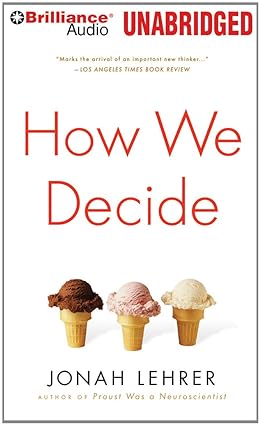
This was the first book I read about the decision process and it´s also one of my favorite.In his illuminating book, “How We Decide,” Jonah Lehrer delves into the fascinating world of human decision-making, unravelling the intricate neural processes that guide our choices. The author exploration takes us on a journey from the biology of the brain to the everyday decisions that influence our lives. From the science of emotions to the art of practical reasoning, the book offers profound insights into the factors that shape our choices. In this post I highlight 20 key lessons from it, providing actionable information for improving decision-making in various aspects of life.
The book reveals the profound interplay between emotions, reason, and our decision-making processes. By exploring the principles of the brain’s emotional and rational systems, Lehrer offers actionable insights that can significantly enhance our capacity to make better choices. From understanding the impact of loss aversion to balancing self-criticism with self-improvement, the book equips readers with a comprehensive toolkit for making more informed and effective decisions. As we navigate the complexities of modern life, these lessons from “How We Decide” empower us to take a more deliberate and thoughtful approach to decision-making, resulting in better outcomes and a deeper understanding of the intricacies of our own minds.
Key Lessons
Continual Training of Dopamine Neurons
Lehrer explains that our emotional decisions are influenced by dopamine neurons, which must be continually trained. Dopamine neurons lose predictive accuracy if not regularly refined. Thus, one must practice vigilance and deliberate retraining to trust their emotions intelligently.
Quality Over Quantity of Practice
When it comes to practice, it’s not just about quantity, but quality. It’s essential to actively consider and learn from the errors your dopamine neurons internalize during the training process.
The Power of Self-Criticism
Even in victory, it’s vital to search for errors and dissect decisions for improvement. Self-criticism is a potent tool for self-improvement, as negative feedback can be the best kind of feedback.
Embracing Mistakes
Rather than discouraging mistakes, we should cultivate them. Mistakes offer valuable insights and opportunities for growth, which are crucial in the learning process.
Fear of Failure Inhibits Learning
Lehrer cites research by Carol Dweck showing that the fear of failure inhibits learning. Embracing and experiencing the unpleasant feelings of being wrong is essential for revising and improving our mental models.
Loss Aversion
The concept of loss aversion, which explains the powerful instinct to avoid losses at all costs. This aversion has significant implications for decision-making, affecting behavior in areas from investing to daily choices.
The Psychology of Holding Losing Stocks
Discussion on the common investing mistake where individuals tend to hold onto losing stocks twice as long as winning ones due to loss aversion. This emotional response postpones the pain of a realized loss, leading to further losses.
The Power of Framing
Explores how framing can influence decision-making. A classic example is the difference between gaining $10 and avoiding a loss of $10. The framing effect shows how our emotions can be swayed by subtle variations in presentation.
Self-Deception and Political Beliefs
highlights on research showing that people tend to reason and interpret information to preserve their existing political beliefs. Our minds edit the world to fit our ideology, often to our own detriment.
The Art of Simulating Feelings
Lehrer explains how sympathy and fairness are rooted in the capacity to simulate the feelings of others. This innate capacity to understand what others are feeling leads to moral decision-making.
Balancing Selfishness and Selflessness
Moral decisionsrequire taking others into account. Balancing selfishness with selflessness is key to making ethical choices.
The Role of Religion (Approx. 80 words): Lehrer suggests that religion serves as a tool to codify and translate the ethics of human evolution into a legal system, allowing us to express our intuitive moral intuitions more effectively.
The Importance of Experience (Approx. 90 words): The capacity for making moral decisions is innate but requires the right experiences to develop. The mind’s sympathetic instincts benefit from experience in making ethical choices.
The Brain’s Bias for Certainty (Approx. 100 words): Lehrer explains the brain’s bias for certainty, where it tends to ignore contradicting evidence to preserve existing beliefs. It’s crucial to continually remind oneself of what remains unknown.
Entertaining Competing Hypotheses (Approx. 80 words): Counteracting the bias for certainty involves entertaining competing hypotheses and looking at information from different perspectives. This helps in making more informed decisions.
Embracing Uncertainty (Approx. 90 words): Embracing uncertainty is essential, especially in complex problems. Lehrer advises against pretending that a mystery has a simple solution, as that can lead to the dangerous trap of certainty.
Thinking About Thinking (Approx. 80 words): Lehrer recommends being aware of the type of decision you’re making and the thought process it requires. Encouraging a mental debate can help in making more thoughtful choices.
Learning from Errors (Approx. 90 words): The best decision-makers embrace errors as opportunities for improvement. Lehrer underscores that constant self-reflection and learning from past mistakes can lead to better decision-making.
Leveraging Simulators (Approx. 100 words): Simulators provide a valuable tool for decision-makers to practice, internalize knowledge, and debrief effectively. They tap into the dopamine system, helping to train the emotional brain.
Emotional and Rational Balance (Approx. 100 words): Lehrer emphasizes the significance of balancing emotions and rationality in decision-making. This equilibrium is critical for making well-informed and prudent choices.